 TESSERA
TESSERA · FEM SOFTWARE · IN DEVELOPMENT
General-purpose finite element analysis, built to be checked.
Tessera is the finite element platform we are building at BadgerMecX — a solver for real engineering models, starting with structures and growing into the physics we already run for clients. The difference is not a feature list: verification, reproducibility and the working behind a result are part of the product.
WHY WE ARE BUILDING IT
The analysis is the easy part.
We run analyses for a living. The hard part is almost never the solver — it is showing, months later and to someone else, that the result can be trusted.
THE PROGRAM
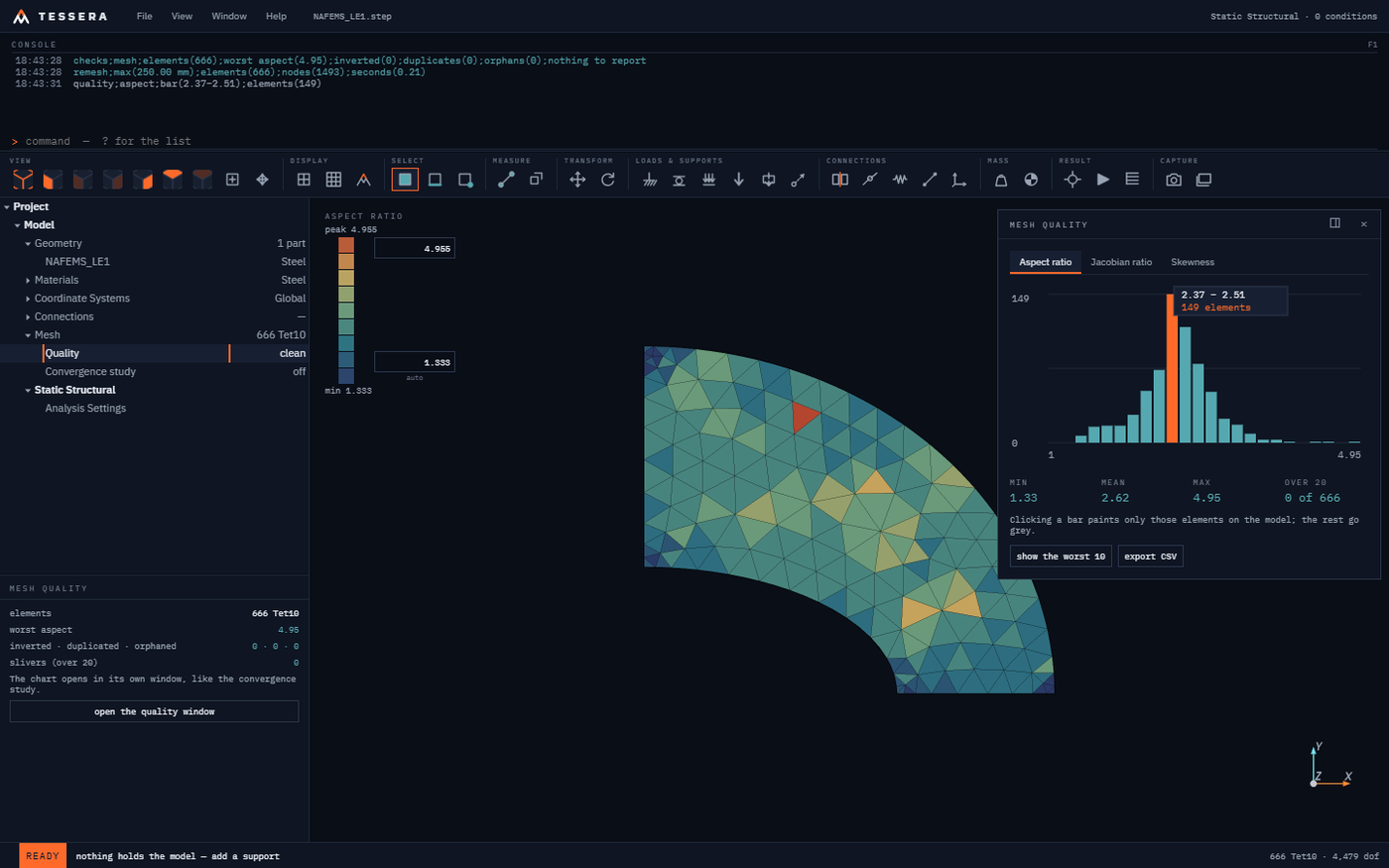
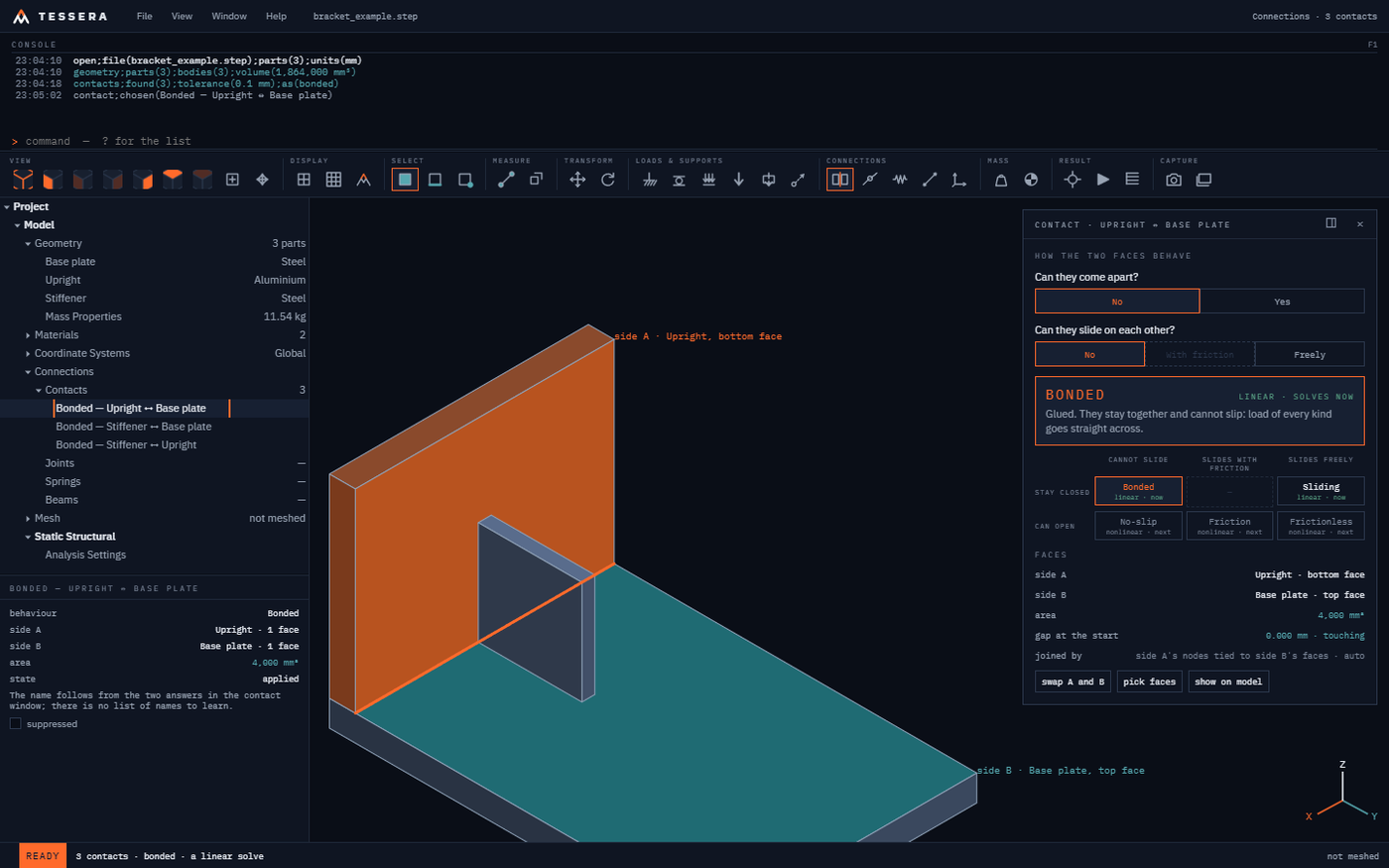
What it looks like today.

HOW WE ARE BUILDING IT
Rules we hold ourselves to.
-
01
Verification is part of the releaseA solver goes out only with its verification set: closed-form solutions, standard benchmarks and hand calculations, published next to it. A release that fails one does not ship.Re-run on every deploy.
-
02
Every run is reproducibleThe engine version, the inputs, the mesh and the assumptions travel with the result, so the same run can be repeated months later by someone else.Reports carry the engine version.
-
03
The working stays visibleWhere a result can be shown step by step, it is: the formulation, the substituted values and the checks behind the number — next to it, not in a help page.
-
04
Your models stay yoursDocumented, open formats in and out. Export is not a paid feature and leaving must always be possible.
-
05
Web-native and scriptableRuns in the browser, scales to the cloud for heavy runs, and anything the interface can do the API can do.
-
06
Built by the people running the analysesWe use it on our own consultancy work before anyone else does. If it does not survive a real deadline and a real reviewer, it is not ready.
-
07
Limits are statedWhere a model is outside its range of validity the software says so, instead of returning a confident number.
WHERE WE WILL BE DIFFERENT
The things we refuse to compromise on.
We do not compare ourselves to any named product — we state what we hold ourselves to.
- USUALLY
- A validation manual, separate from your model
- TESSERA
- Published with the solver, re-run on every release
- USUALLY
- Version, settings and inputs scattered across files
- TESSERA
- Version-stamped, repeatable run
- USUALLY
- A number out of a black box
- TESSERA
- Result plus the working behind it
- USUALLY
- Proprietary formats; export as an upsell
- TESSERA
- Open formats, export included
- USUALLY
- Local install, drivers, licence server
- TESSERA
- Browser and API from day one
- USUALLY
- Per-seat licences decide who may check
WHO IS BUILDING IT
Engineers who run these analyses for a living.
We run finite element and flow analysis as consultancy work — structural FEA, CFD, vibration and NVH, thermal and acoustics — from concept validation to regulatory approval, for [XX] years. Tessera exists because we keep hitting the same walls in our own projects, and because we already know what a result has to survive: a client, an independent reviewer and an approval body.
What we do for clients →SCOPE
What it will do, and where each part stands.
ROADMAP
Stages, not dates.
A stage goes live when its release condition is met — not when a date arrives.
- Stage 1 Solver core and verification suite The element library, the linear solver and the test set it must pass on every release. The free calculators run on it in public. RELEASE CONDITIONEvery engine reproduces its reference set before release.
- Stage 2 Workspace: models, runs and reports Save a model, keep the run history, export a version-stamped report. RELEASE CONDITIONProven on our own client jobs first.
- Stage 3 2D structural models in the browser Build the model in the interface, run the linear solver on it, read the results in the same place. RELEASE CONDITIONA published benchmark set reproduced against reference solutions.
- Stage 4 3D frames, plates and shells Full 3D structural modelling with meshing and convergence control. RELEASE CONDITIONValidation against reference models and independent cross-checks.
- Stage 5 Dynamics and nonlinear Modal analysis, response spectra, large displacement, plasticity and contact. RELEASE CONDITIONLiterature benchmarks reproduced within a stated tolerance.
- Stage 6 Open API and automation Everything the interface can do, from a script. RELEASE CONDITIONIdentical results through the API and the interface.
WHILE WE BUILD
Free calculators, open to everyone.
Small, single-purpose tools we publish for free. They run on the same solver core and the same verification suite, and they need no account.
EARLY ACCESS
Be in the first group to use it.
Tell us what you analyse. We open access stage by stage and the early group helps decide what is built next.
- We write personally before each stage opens.
- No newsletter, no list sharing — you can ask us to delete your entry at any time.
- Pilot partners help decide what is built next.