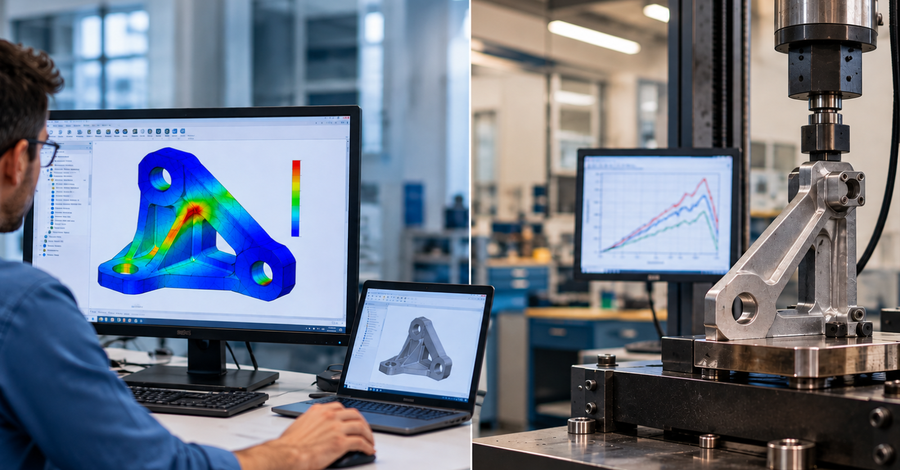
"Can we simulate this instead of testing it?" is one of the most frequently asked questions in engineering project management — and one of the least consistently answered.
The honest answer is: it depends on what you're trying to learn, how much certainty you need, and what the cost of being wrong looks like. Simulation and physical testing are not interchangeable. They answer different questions with different confidence levels, and the best engineering projects use both deliberately rather than treating one as a budget-driven substitute for the other.
This article lays out a practical framework for deciding when to simulate first, when to test first, and when the two need to work together.
What Simulation Actually Does
Finite element analysis, CFD, and multibody dynamics simulations solve mathematical models of physical systems. They produce results that are only as good as:
- The accuracy of the geometry and mesh
- The realism of the material models
- The appropriateness of the boundary conditions and loads
- The validation of the solver and analysis approach against known physical behaviour
Simulation gives you a prediction. Whether that prediction matches reality depends on how well the model captures the relevant physics. A simulation of a simple steel beam under a static point load will match physical measurements very closely — the physics is well understood, the geometry is simple, the material model is mature. A simulation of high-cycle fatigue crack initiation in a complex welded joint under multiaxial loading is a much harder problem — the prediction carries more uncertainty.
This distinction matters because it defines where simulation adds value without additional physical evidence.
What Physical Testing Actually Does
Physical testing measures what actually happens in a specific specimen under specific conditions. Its strengths are the opposite of simulation's:
- It captures the real geometry, including manufacturing imperfections
- It captures the real material behaviour, including variability and defects
- It captures the full physics — including interactions the model didn't include
- The results don't depend on modelling assumptions
Its limitations are also real:
- It is expensive and time-consuming, especially at full scale
- It tests specific conditions — generalising results to other load cases or geometries requires care
- Instrumentation captures what you measure — physics happening elsewhere in the specimen may be missed
- Failure during testing is informative but potentially costly
The Decision Framework: Five Scenarios
Scenario 1: Well-understood physics, standard geometry, established material
Recommendation: Simulate. Test only for certification if required.
For structures that fall squarely within the validated range of established analysis methods — standard steel or concrete structures under static loads, heat exchangers within standard operating parameters, rotating machinery within the scope of API or similar standards — simulation alone is generally sufficient for design verification. Physical testing is only added when certification explicitly requires it (e.g. proof load testing for lifting equipment) or when a specific performance parameter cannot be predicted with adequate confidence.
Scenario 2: Novel geometry or loading, but established material and physics
Recommendation: Simulate first to identify critical regions, then test selectively.
When the geometry or load combination is unusual but the underlying physics is well understood, simulation can efficiently map the design space, identify critical locations, and guide test planning. Testing is then concentrated on the critical regions rather than requiring a full qualification test program upfront.
This is standard practice in aerospace structural development — FEM identifies critical load cases and critical locations, and test articles are instrumented to verify the simulation at those specific points.
Scenario 3: Novel material, complex joint behaviour, or poorly characterised failure mode
Recommendation: Test first to characterise, then simulate.
When the material model is uncertain — a new alloy, a composite with poorly characterised interlaminar properties, a bonded joint with unknown fatigue behaviour — simulation is only reliable once the material model has been calibrated against test data. Testing comes first to generate the data that makes simulation trustworthy.
The same applies when the dominant failure mode is not well modelled. Fretting fatigue, corrosion-accelerated cracking, and delamination under impact are examples where simulation results carry significant uncertainty without supporting test data.
Scenario 4: Safety-critical or certification-driven applications
Recommendation: Simulate throughout, test for formal qualification.
For aircraft, pressure vessels, lifting equipment, and other safety-critical applications, simulation is used throughout the design process — for exploration, optimisation, and verification — but physical testing remains mandatory for formal qualification. No amount of simulation eliminates the requirement to demonstrate physical conformance to the applicable standard.
Here, simulation and testing are not alternatives; they are sequential steps in the same qualification process.
Scenario 5: Failure investigation
Recommendation: Simulate to explain, test to verify the explanation.
When a structure or component has failed in service, simulation is used to reconstruct the failure mechanism and identify root causes. The simulation model is informed by the failed component's geometry and the operating conditions at the time of failure. Physical testing of samples from the failed part (fractography, hardness testing, chemical analysis) provides the evidence that validates the simulation-based explanation.
Simulation Replacing Testing: Where the Boundary Lies
Regulatory acceptance of simulation as a substitute for physical testing has expanded significantly over the past two decades — driven by validated software, improved material databases, and increasing confidence in computational methods. However, the boundary is not defined by computing power. It is defined by validation.
Simulation can replace testing when:
- The analysis method has been validated against physical tests for similar problems
- The material models have been calibrated with appropriate test data
- The boundary conditions can be reliably defined
- The result is not sensitive to parameters that cannot be known with confidence
Simulation cannot replace testing when:
- The dominant failure mode has no reliable analytical model
- Material variability significantly affects the result and cannot be characterised analytically
- The regulatory framework requires physical demonstration regardless of analytical confidence
- The consequence of the simulation being wrong is unacceptable and testing is feasible
The Value of Pre-Test Simulation
Even when physical testing is required, simulation before the test adds significant value:
Test planning: Simulation identifies the load cases and specimen locations most likely to reveal critical behaviour. This focuses instrumentation where it matters.
Go/no-go prediction: If the simulation predicts failure at 80% of the test load, you know to instrument for that load range. If it predicts safe behaviour to 150% of test load, you have a quantified prediction to compare against.
Avoiding test article failure: For expensive test articles — a full-scale prototype, a qualification specimen — knowing approximately where and how failure initiates allows the test to be stopped before catastrophic loss of the article.
Interpreting results: When test results diverge from simulation predictions, the discrepancy itself is informative. It points to something the model missed — a load path, a boundary condition, a material behaviour. This iterative process between simulation and test is how models get better.
Summary
Simulation and physical testing are complementary tools, not competitors. The right balance depends on what you're trying to learn, how well the physics is understood, and what the certification or safety context requires.
The most common mistake is treating simulation as simply a cheaper version of testing — using it to reduce cost without asking whether the modelling assumptions are valid for the problem at hand. The second most common mistake is the opposite: defaulting to physical testing when well-validated simulation would give a faster, equally reliable answer.
A structured decision at the start of the project — what do we need to know, and what method best answers that question — avoids both.